

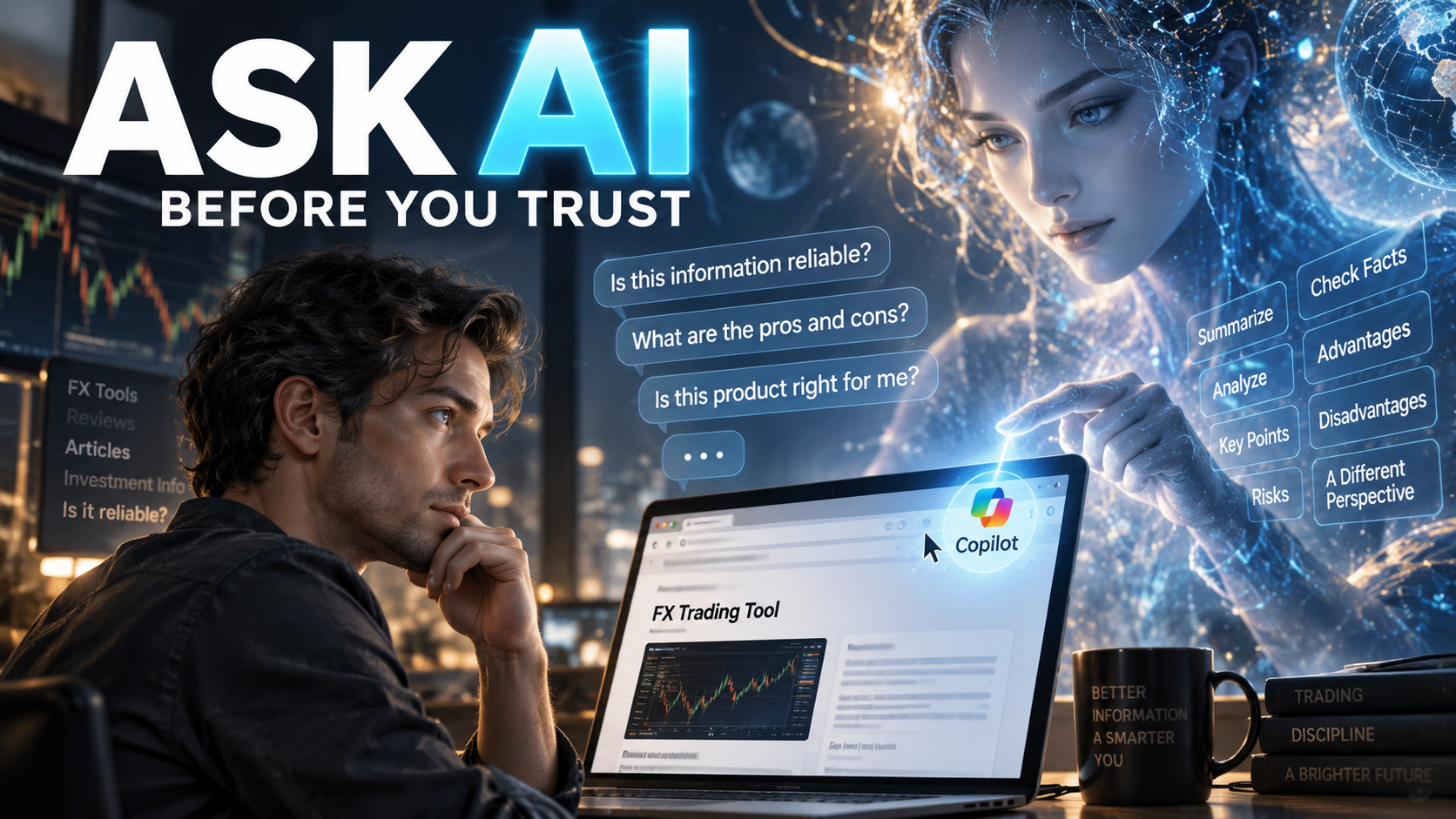
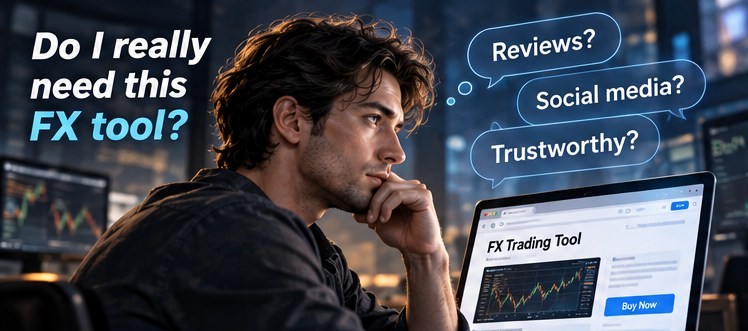
“Do I really need this FX tool?”, “Can I trust this investment information?”
When people considered buying a product in the past, they would usually search for reviews, read the sales page, check user comments, or look for opinions on social media.
But things are changing.
Today, you can simply ask AI while you are looking at the page.
Modern browsers are increasingly integrating AI features. In Microsoft Edge, for example, you can open Copilot from the browser toolbar and ask questions about the webpage you are currently viewing.
Copilot can use the page context to answer questions, summarize content, and help analyze what you are reading.
You can simply ask:
- What do you think about this article?
- Is this information reliable?
- Does this product look useful?
- What are the advantages and disadvantages?
The AI can then organize the information on the page and highlight its main points, features, and potential concerns.
It is a surprisingly simple way to check information.

😂 “Is This Information Really Correct?” — Just Ask AI
One interesting use case is investment-related content itself.
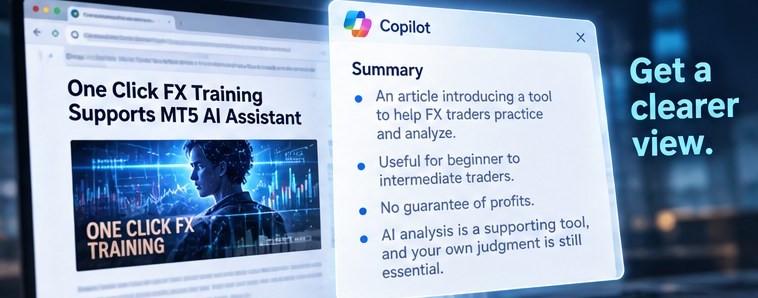
For example, I opened an FX-related article in Edge and asked Copilot:
“What do you think about this article?”
The article was analyzed and summarized as information about a tool designed to help beginner to intermediate FX traders practice and analyze their trading.
Copilot also organized the product’s features, potential benefits, and limitations.
For example:
- It can provide a useful environment for practice.
- There is no guarantee that using it will make you profitable.
- AI analysis is a supporting tool, and traders still need to develop their own judgment.
This is the kind of analysis AI can provide when you ask it to examine the content of a webpage.
But there is an important point here.
This does not mean that AI gives you “the correct answer.”
AI can make mistakes. Its response is simply another source of information, and it is not necessarily the optimal conclusion.
However, consider what has changed.
Previously, you might read an article, think “That sounds reasonable,” and move on.
Now, you can ask an AI to look at the same information from another perspective.
That is genuinely useful.
As more people start using AI to check information on a daily basis, it may also become easier to identify questionable claims, misleading information, or potentially fraudulent content.
For people consuming information online, this could be a significant change.

😏 A Time When “What AI Thinks” Could Affect What Survives?
Until now, choosing an investment product or FX tool often required collecting information from several sources.
You might read the sales page, search for reviews, check social media, and compare different products before making your own decision.
But as AI becomes more accessible, you can ask questions about that information immediately.
For example:
- Is this claimed win rate supported by evidence?
- Does this explanation have a reliable basis?
- Tell me the disadvantages as well as the advantages.
- Is this product actually relevant to a beginner like me?
This is a major change not only for product sellers, but also for anyone publishing information online.
In the past, even information that simply looked convincing might have reached readers.

But if readers can now ask an AI, “Is this really true?”, the situation changes.
Of course, AI will not become a perfect judge of truth.
Even so, the tools available for comparing information, organizing it, and identifying questions have become dramatically more accessible.
That makes the idea that “things that cannot stand up to AI scrutiny may eventually be filtered out” less surprising.
AI does not have to choose a product for you.
Instead, you can use AI to gather information, check what you are being told, and then make your own decision.
The environment for using AI casually is already here.
🤔 Actually, This Is a Little Chilling
AI is not a tool that should decide what you should buy.
Instead, when you have questions about an investment product or FX tool, AI can act as another perspective.
You can ask questions immediately, organize the potential benefits and limitations, and then make your own judgment.
With Edge, for example, you can open a webpage and ask Copilot about the content directly.
Perhaps we are moving from an era of simply “looking at advertisements” to an era of “asking AI while deciding what to choose.”
And honestly, that is a little chilling for sellers, bloggers, and influencers.
On the other hand, it could also create an opportunity for developers who have genuinely worked on their products and bloggers who have consistently provided accurate information.
They may have a better chance of being evaluated on the substance of what they provide.
The same applies to Practice Simulator.
Try asking AI about it. Ask difficult questions.
We did not develop our products simply to receive a good evaluation from AI.
But if users increasingly use AI to examine products and information for themselves, whether a product can withstand that kind of scrutiny cannot be ignored.
That is why developers will need to take product development more seriously than ever.

Summary
AI does not eliminate the need for human judgment.
Instead, it gives people another way to question, compare, and examine the information in front of them.
For FX traders, this can be especially useful.
Before buying a tool, reading an article, or believing a claim, you can simply ask AI:
“Is this really true?”
The answer may not always be correct.
But asking the question itself is becoming easier than ever.
And that may change the relationship between users, information, products, and the people who create them.