

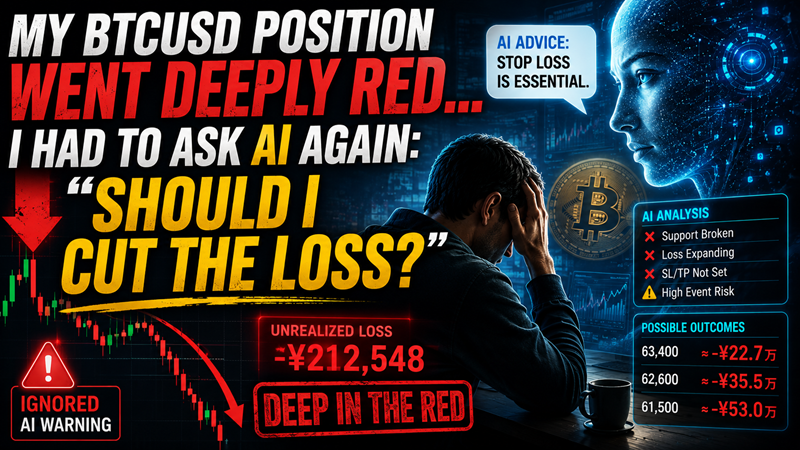
What Happens If You Ask AI About a Stop-Loss, Get Warned That It’s Dangerous, and Still Leave the Position Open?
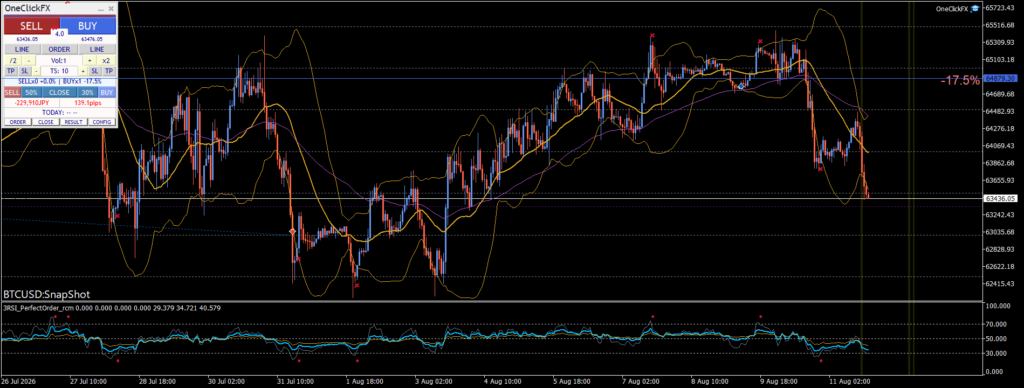
This time I entered BTCUSD. The trade briefly looked bullish, then peaked out around the RSI exit mark and dropped sharply. It even printed an oversold signal.
Yesterday I asked the MT5 AI Assistant about cutting the loss. It advised that a stop-loss (SL) is essential even when the position is already in the red.
And then… I left it alone.
A small bounce made me think, “Maybe it can still recover.” Then it dropped again. This time I consulted the same position a second time.
The blue horizontal line is the breakeven line. A buy-entry mark appears shortly before 9 Aug 18:00. The red × marks are the 3RSI exit marks.

- MT5 AI Assistant output
- 📊 Open position analysis (overall)
- 📰 BTCUSD-related news (as of 8/11)
- 📌 Implications for the open position (summary)
- 💡 Conclusion
- My view (decision material only)
- 🤔 Was this AI Assistant actually useful in a live situation?
- 😵 Even if you consult AI, you still make the last decision
- AI output is genuinely useful as reference
MT5 AI Assistant output
apply https://license.ioiv.net/ai/en/menu.txt
Rules applied. Past records from the saved file have also been loaded.
✅ AI rules applied
Contents of https://license.ioiv.net/ai/en/menu.txt have been applied.
MT5 AI Assistant
What would you like to do?
- Check the news
- Analyze the chart
- Consult on entries / exits
- Analyze open positions
- Review trades
- Analyze signals / indicators
Enter 0 to return to the main menu. You can also just type a normal question instead of a number.
4
I checked your current open positions.
Open positions:
| # | Symbol | Direction | Lot | Entry | Current | Floating P/L |
|---|---|---|---|---|---|---|
| 1 | BTCUSD | BUY | 1.0 | 64,826.95 | 63,492.25 | −212,548 yen (including −8,323 yen swap) |
(No pending orders)
Select a position to analyze.
- BTCUSD
- Overall
- Back to menu
2
📊 Open position analysis (overall)
Key conclusion first
The current portfolio is a single BTCUSD long. Risk is 100% concentrated in Bitcoin. Price has already broken the 63,800 line used as a decision level in the previous session and is now around 63,490. The floating loss has widened from about −110,000 yen last time to about −213,000 yen. With no SL/TP set, there is no mechanism to stop further downside.
1. Position details
| Item | Details |
|---|---|
| Symbol | BTCUSD |
| Direction | BUY |
| Lot | 1.0 |
| Entry price | 64,826.95 (8/9 09:10) |
| Current price | about 63,490 |
| Floating P/L | −212,548 yen |
| Swap | −8,323 yen |
| Total floating P/L | about −213,010 yen |
| SL / TP | Not set |
| Source | Expert (EA / OneClickFX) |
※ Demo account (******)
2. Account status
| Item | Amount |
|---|---|
| Balance | 1,310,290 yen |
| Equity | 1,088,957 yen |
| Used margin | 19,063 yen |
| Free margin | 1,069,894 yen |
The floating loss is about 16.3% of balance. There is no margin-call crisis right now, but the loss is still expanding.
3. Current chart picture
Daily (D1):
- Correction from the 7/21 high at 66,942 → drop to 62,200–62,400 on 8/1–8/3
- Recovery toward 65,450 by 8/9 → then two large down candles on 8/10–8/11
- 8/11 low 63,421, close 63,489: signs of a downside break
Hourly (H1):
- Previous support at 63,800–64,000 clearly broken
- Price is hugging the recent low zone at 63,400–63,500 (8/11 low 63,421)
- Rebound volume is weak; little buying power to test higher levels
4. Key price zones
| Type | Zone | Meaning |
|---|---|---|
| Nearest support | 63,400–63,500 | 8/11 low. A break opens the downside |
| Next support | 62,500–62,700 | 8/1–8/3 lows |
| Further down | 61,500 | June low area |
| Resistance 1 | 64,000–64,300 | Broken support now acting as a sell-the-rally wall |
| Resistance 2 | 64,800–65,000 | Entry zone / psychological level |
| Resistance 3 | 65,400–65,500 | 8/10 high |
5. Risk estimate (how the floating loss could grow)
| Price reached | Estimated loss | % of balance |
|---|---|---|
| 63,400 (recent low) | about −227,000 yen | 17.3% |
| 62,600 (next support) | about −355,000 yen | 27.1% |
| 61,500 | about −530,000 yen | 40.4% |
※ Rough figures. Actual P/L will differ with swap and spread.
6. Problems at the portfolio level
- 100% concentration in one symbol and one direction — all risk sits on a single BTCUSD long
- No SL/TP — losses can keep growing with nothing to stop them
- Entry near a high — bought around the 65,000 resistance area (just after the July high of 66,942)
- Decision line already broken — the previous “watch 63,800” line has already given way
- Loss already over 16% of balance — a large floating loss from a risk-management standpoint
7. How to read what comes next (decision material)
- Bullish case: price holds 63,400–63,500 and recaptures 64,000–64,300 → a bounce from the dip is possible
- Bearish case: a break of 63,400 opens 62,500–62,700. A further break puts 61,500 in play
- Caution: with no SL/TP, downside losses have “nobody to stop them.” You must make the decision yourself (I do not execute trades)
If you want to go deeper
- Consider a stop-loss (SL) — where would a reasonable level be
- Consider a take-profit (TP) — targets if price recovers
- Analyze the current chart in more detail
- Check related news (latest Bitcoin market drivers)
- Estimate risk if price falls further
- Compare holding vs. closing the position
- Back to menu
4
📰 BTCUSD-related news (as of 8/11)
Sorted by importance.
🔥 Most important: U.S. CPI is imminent — markets are on a knife edge
- “July CPI Puts Bitcoin and Markets on a Fed Knife Edge”
- “Will July CPI Reset the Fed, Bitcoin, and Every Major Market?”
- CPI was already the key follow-up item from the previous session. The print can move BTC sharply either way.
📉 Selling pressure (bearish)
- Strategy (MicroStrategy) sold Bitcoin for a second straight week — “Why Strategy Is Selling Bitcoin” / “Saylor’s Strategy Sells Bitcoin for Second Week in a Row”
- A whale sold 1,274 BTC (about $81.5 million) across several venues
- A BlackRock-linked address moved 838 BTC to Coinbase (about $77.84 million) — a possible sell signal
- FalconX deposited 300 BTC to Coinbase (about $19.18 million)
- A Nordic firm is rising as Europe’s No. 2 corporate BTC treasury, while large holders keep selling
📈 Buying factors (bullish)
- Whales accumulated 46,000 BTC — though weak network activity still clouds the recovery
- BTC holding up alongside ETF inflows (DailyForex technical analysis)
- Arthur Hayes: “A Fed yen rescue would lift BTC, gold, and ETH” — yen-intervention talk seen as a tailwind for risk assets
⚠️ Other points
- Gold above $4,400 — Peter Schiff argues “sell BTC and Strategy stock, buy gold” (a possible capital-rotation story)
- CryptoQuant corrected its reading of CME positioning — BTC leveraged funds are not net long overall
- Newer holders are approaching breakeven; 3–6 month holders are underwater
📌 Implications for the open position (summary)
Selling pressure continues, while the market lacks direction ahead of a “must-watch” CPI event. Whale accumulation and ETF inflows are bounce factors, but price has already broken 63,800 and sellers currently have the edge. CPI can produce a sharp move up or down. Riding that event with no SL/TP means taking on more volatility than planned.
If you want to go deeper
- Confirm CPI date/time and consensus
- Check Bitcoin ETF flows in more detail
- Look more closely at Strategy’s sales
- Organize how this news affects the open position
- Check spillover into other markets (USDJPY, etc.)
- Back to menu
“So I have no choice but to cut the loss?”
That’s the question: should you cut it? I’ll answer directly.
💡 Conclusion
I would not say “the only option is to cut.” But the conditions for considering a stop-loss are already well in place. At minimum, the one choice you most want to avoid from a risk-management standpoint is leaving the position with no SL set and riding through CPI.
Why a stop-loss is becoming the more rational option (bearish factors)
- The 63,800 decision line has clearly broken — the level flagged as “watch this” last session is already below price
- Floating loss is over 16% of balance (about −213,000 yen), with no SL/TP
- Selling pressure is dominant — Strategy’s second week of sales, a 1,274 BTC whale sale, BlackRock-linked exchange transfers
- Rebound volume is weak — even a bounce has little buying power overhead
- A high-volatility event (CPI) is imminent — a downside surprise can balloon the loss quickly
- If price falls further: 62,500–62,700 implies about −350,000 yen (27% of balance)
Why you don’t necessarily have to cut immediately (bullish factors)
- Price is near the recent low of 63,421 — a bounce from support is still possible
- Whales accumulated 46,000 BTC, and ETF inflows continue
- A dovish CPI (rate-cut hopes) could spark a sharp rebound — Arthur Hayes also sees a Fed yen-rescue → BTC-up scenario
- This is a demo account, so there is no real-money loss — there is still learning value if that is the goal
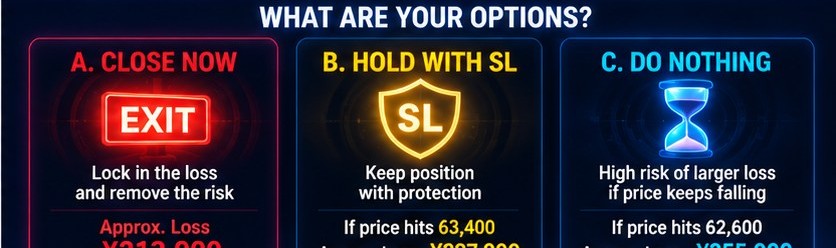
📊 The decision fork
| Option | What it means | Loss estimate |
|---|---|---|
| A. Cut now | Lock in the loss and exit the risk | about −213,000 yen (16.3% of balance) |
| B. Set an SL and hold | Auto-exit on a 63,400 break; wait for post-CPI direction | about −227,000 yen if 63,400 breaks |
| C. Leave it | Ride the event; downside expands the loss | about −355,000 yen at 62,600 |
Point: current price (~63,490) is almost on top of the 63,421 recent low. If your rule is “cut if 63,400 breaks,” that is effectively almost the same decision as cutting now.
My view (decision material only)
- Technical: support is already broken, so continuation of the downtrend is more likely
- Fundamental: selling pressure is stronger, but CPI can still change the tape
- Overall: if you are going to cut, “now, while still in the support zone” is the least-bad price. If you hold, set an SL and resolve the trade before CPI (likely the night of 8/12 Japan time; confirm the exact time on an economic calendar)
The final decision is yours. I only analyze and provide information. I do not close trades or change orders.
If you want more, just ask in normal language — for example, “Where specifically should I put the SL?”, “I want more detail on CPI’s impact,” or “If I hold, help me think through a plan.”
That is the end of the AI Assistant’s reply.
🤔 Was this AI Assistant actually useful in a live situation?
The important point this time is that the AI did not prophesy “BTC will go up” or “BTC will go down.”
It checked the open position, floating loss, account balance, chart, support, resistance, and news, then put numbers on what can happen if you keep holding.
It also carried forward the previous consultation and checked what actually happened to the last decision line: “63,800 has broken.”
That is a much more interesting use of AI than treating it as a fortune-teller who is supposed to “get the call right.”
When humans sit on a floating loss, hope creeps in: “Maybe it will bounce a little more.”
Have the AI organize the current situation. Then make the final call yourself.
With that division of roles, an AI assistant becomes quite practical.

😵 Even if you consult AI, you still make the last decision
In this case, the AI already pushed risk management last time, and it analyzed the situation again this time.
What to do with the position is still the trader’s call.
The value of the AI Assistant is not issuing an order to “cut the loss.”
It is calmly laying out:
- how far the loss can grow if you keep holding
- what the current decision factors actually are
- how hold / cut / set an SL differ from each other
If it can organize things that way in a floating-loss situation — when emotions run high — it becomes something a little different from a plain chart-analysis tool.

AI output is genuinely useful as reference
This BTCUSD case is interesting less as a “should I stop-loss or not” story and more as a real example of using the MT5 AI Assistant inside a live trading decision.
It inherited the previous consultation, re-analyzed the current position and market backdrop, and put numbers on how much worse the loss could get.
Of course, some experienced traders will still trust their own judgment more than AI. Even then, there is value in using AI analysis as one information source and as a third-party check.
You can know in your head that “cutting would be better” and still delay the decision once you are in a floating loss. Or the AI may point out a risk you had not noticed.
If that only means you cut a little earlier, or skip one unnecessary entry, it can still change results over a long stretch of trading.
Don’t obey the AI. Add one calmer viewpoint to your own judgment.
Thanks to MT5’s AI Assistant, the kind of “ask AI about a trade” setup that used to be available only to a few people is finally becoming something ordinary traders can use.